
One Platform for Compliance and Operations. No More Tool Sprawl.
Stratus GRC-ITSM
For organizations running compliance programs across FedRAMP, CMMC, or DoD CC SRG that are tired of stitching together five or more disconnected tools to manage GRC and IT operations.
Get a Demo
Running a compliant environment requires more than a GRC tool. You need ticketing, vulnerability tracking, change management, document generation, reporting, and operational workflows. Most organizations cobble this together across five or more disconnected tools from different vendors.
Stratus GRC-ITSM consolidates compliance and operations into a single platform built on HaloITSM. Everything runs in one place, with one data model and one source of truth, so compliance is a byproduct of operations, not a separate workstream.
We built it for ourselves first. Stratus manages 15+ compliant environments and has delivered 500+ ConMon packages, and Stratus GRC-ITSM itself is FedRAMP 20x Moderate Authorized. Our clients run their FedRAMP, CMMC, and DoD environments on it, and our managed services are backed by it.
The workflow is the evidence: the ticket is the audit trail, the approval is the evidence, and reports generate from the data produced while doing the work. Read how we got here in the 9 operational disciplines every compliance framework tests.
COST
One platform vs. five+ tools
Complexity
One login, one workflow engine, one reporting layer
RISK
No data silos, no sync failures, no gaps between tools
Capabilities
Security and Compliance Operations
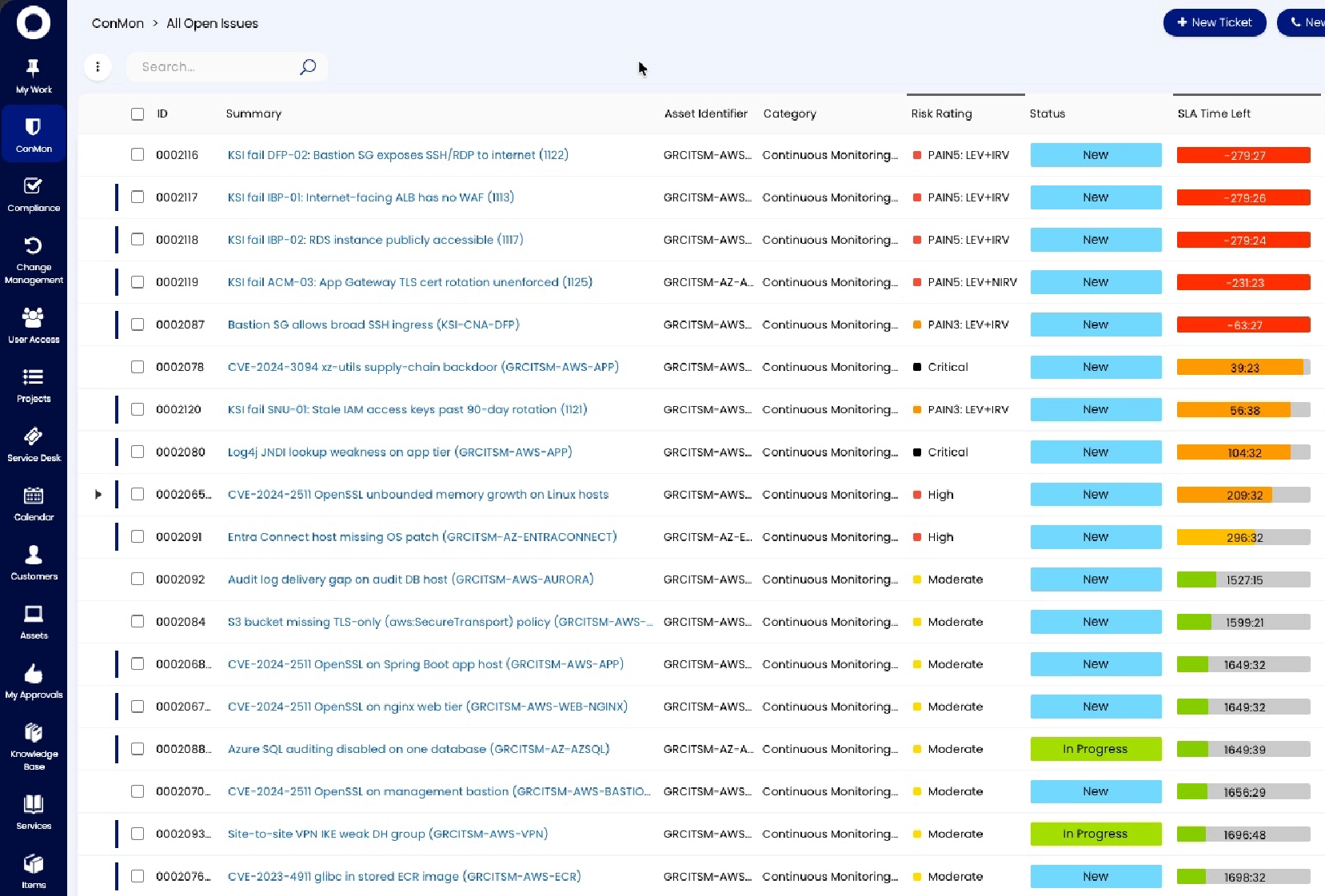
- Vulnerability Management. Ingests normalized and enriched vulnerability data from all scan tools. Findings are automatically enriched with CISA KEV status, EPSS scores, and threat intelligence feeds to determine exploitability. Combined with live asset inventory and environmental context to assess the Potential Agency Impact N-rating (PAIN, N1–N5). Every finding becomes a tracked issue ticket with SLAs aligned to severity. How we built vulnerability management across CMMC, Rev5, and 20x.
- Issue & Risk Tracking. All findings, vulnerabilities, and risks are tracked as issue tickets with full lifecycle management: creation, triage, remediation, verification, and closure. SLA enforcement ensures nothing ages out silently. This is your risk register: live, auditable, and tied directly to the controls and assets it affects.
- POA&M Management. Full lifecycle tracking from finding to closure with milestones, status updates, and audit trails. There is no separate POA&M object: a POA&M entry is the same issue ticket, flagged when it meets the criteria, so the finding, the POA&M, and the remediation change stay one connected record. Deviations (operational requirements, false positives, risk adjustments) are linked directly to their parent POA&Ms, and reporting that ties the two together is generated automatically, not maintained by hand.
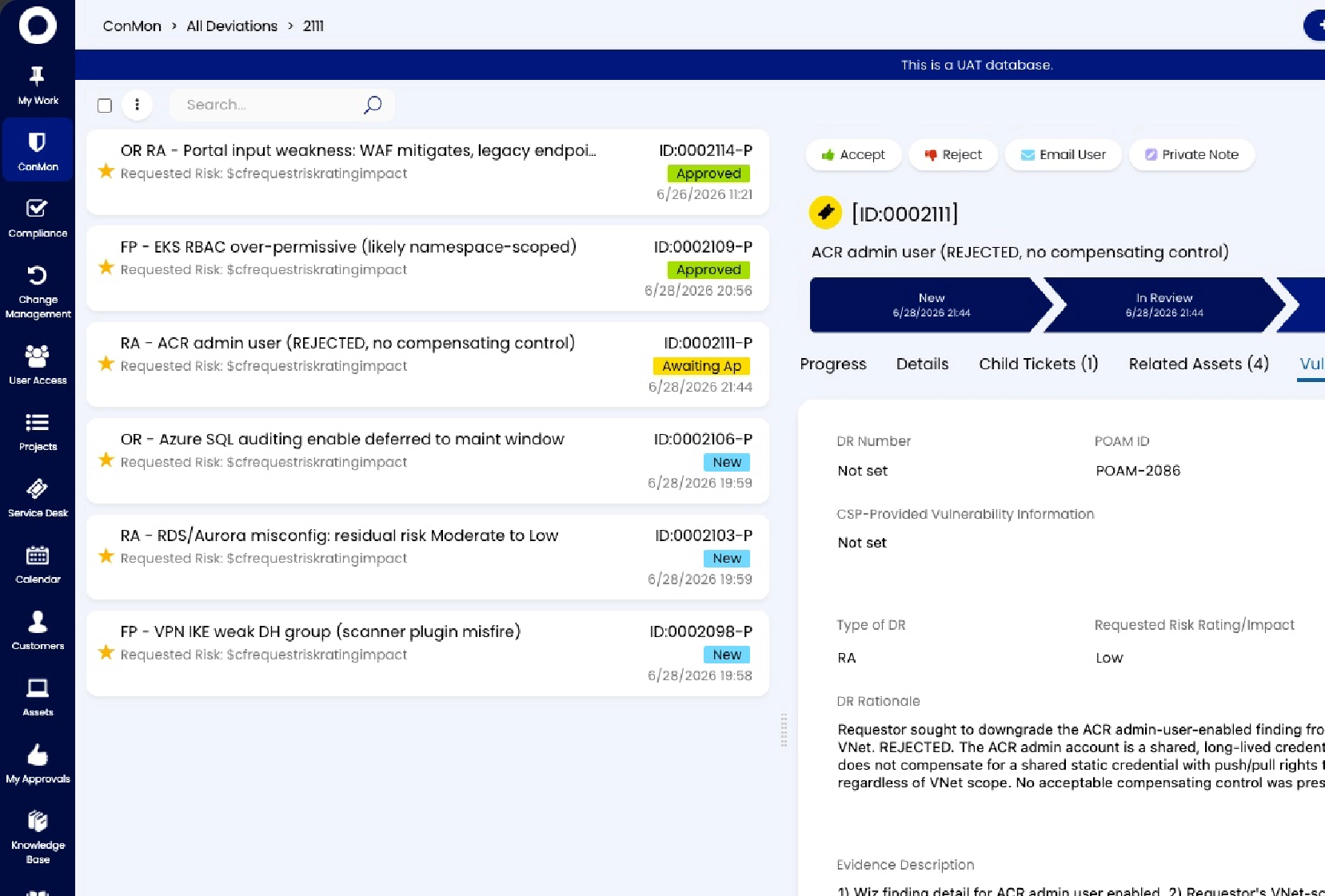
- Vulnerability Deviation Management. Full lifecycle tracking of operational requirements, false positives, and risk adjustments. Each deviation is documented with justification and expiration, and linked to its parent issue/POA&M. When a deviation is approved, the downstream reporting updates automatically with no manual reconciliation between your deviation tracker and your POA&M report. How we built deviation management across CMMC, Rev5, and 20x.
- Asset Inventory. Live, automatically synced inventory of all cloud resources within the authorization boundary. Integrations pull inventory directly from your cloud environment so your asset register stays current without manual updates. How we built asset inventory across CMMC, Rev5, and 20x.
- Reporting. Generate ConMon monthly packages, POA&M exports in FedRAMP-required formats, and Ongoing Certification Reports (OCRs, formerly OARs). Reports are live views of platform data, current and historical, not static exports that go stale. Accessible through the self-service portal with granular RBAC. How we built compliance reporting across CMMC, Rev5, and 20x.
- OSCAL-Based System Definition. Define your system using OSCAL layers: Components, Capabilities, Implemented Requirements, and System Information. Your compliance data is structured and machine-readable from day one, not trapped in Word documents. Use it to auto-generate SSPs, policies, and certification artifacts directly from the platform, including the machine-readable JSON submissions the FedRAMP Consolidated Rules for 2026 require. How we built OSCAL-based documentation across CMMC, Rev5, and 20x.
ITSM Modules
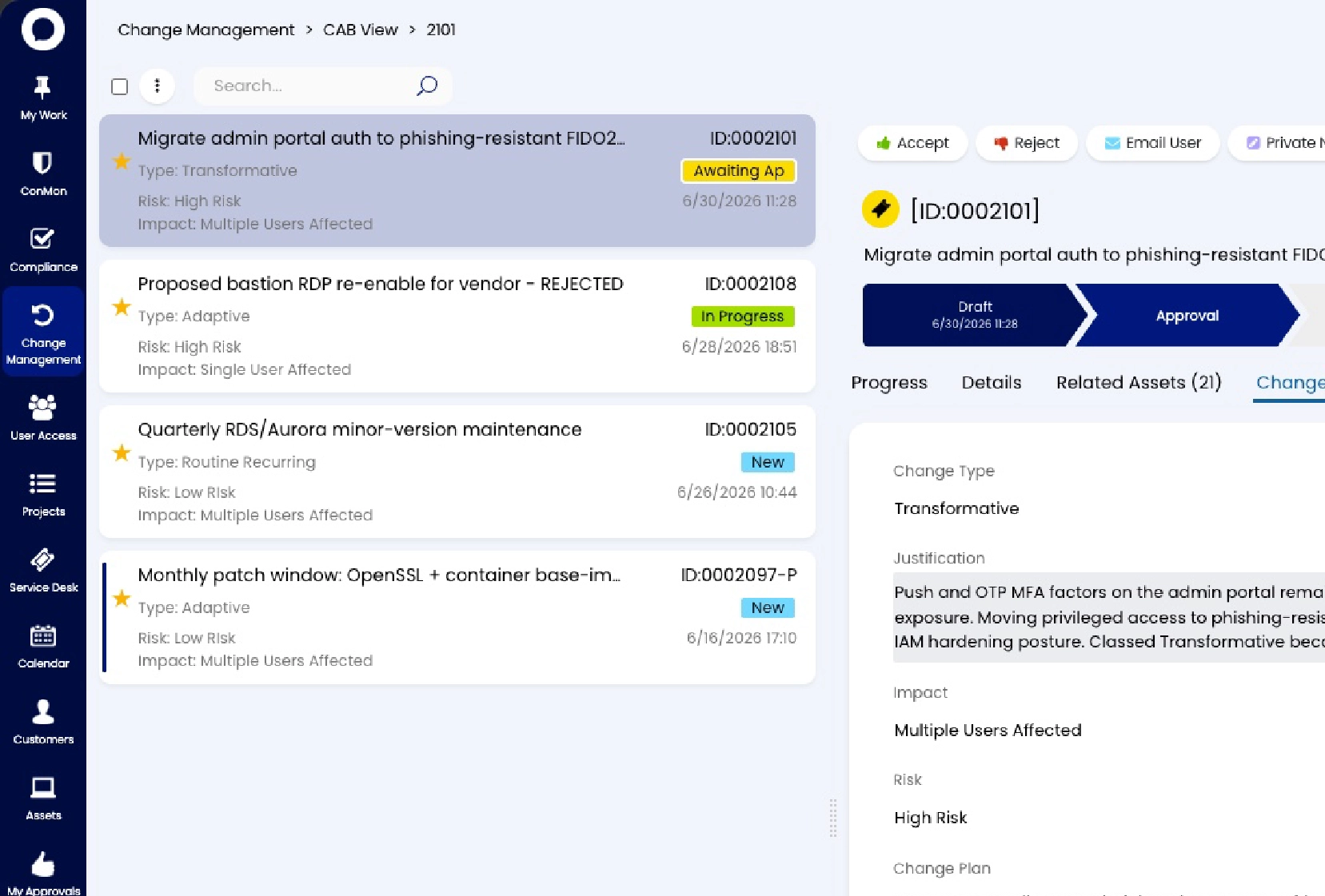
- Change Management. Structured change request workflows with automated approval processes, role-based notifications, and Change Advisory Board routing. Approval and notification roles are defined by change type and need-to-know. Full SLA tracking on every change request. How we built change management across CMMC, Rev5, and 20x.
- Incident Management. All incidents tracked as tickets with defined POCs who are automatically notified. Escalation paths, response plan integration, and post-incident review workflows built in. Supports tabletop exercises and after-action tracking. How we built incident response across CMMC, Rev5, and 20x.
- User Access Requests. Self-service access provisioning with approval workflows, role-based routing, and integration with access review cycles. How we built user access management across CMMC, Rev5, and 20x.
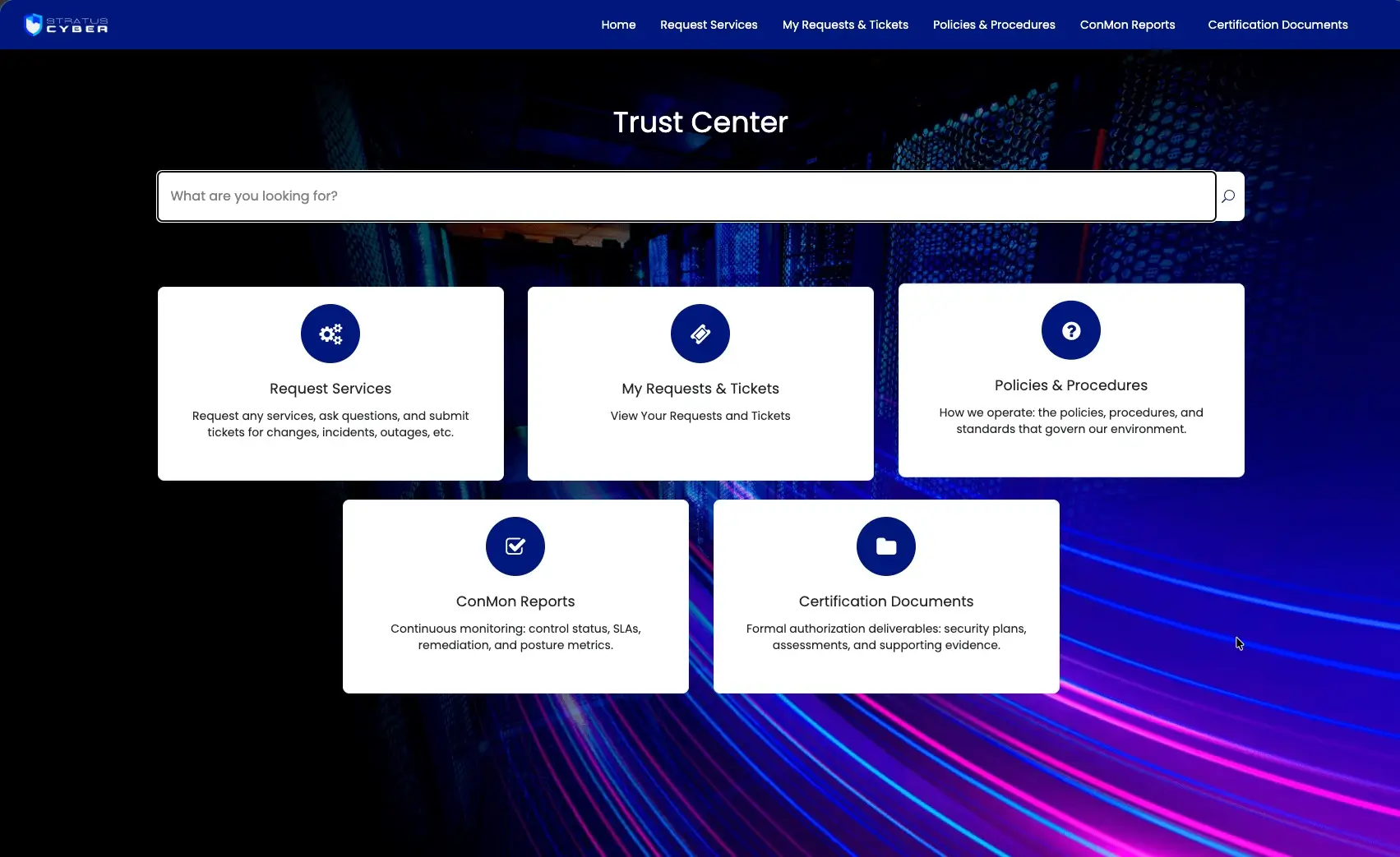
- Self-Service Portal. End users and stakeholders access the platform through a portal with granular RBAC. Submit requests, view certification data, check ticket status, and pull reports, all with secure authentication and access logging.
Reporting & Analytics
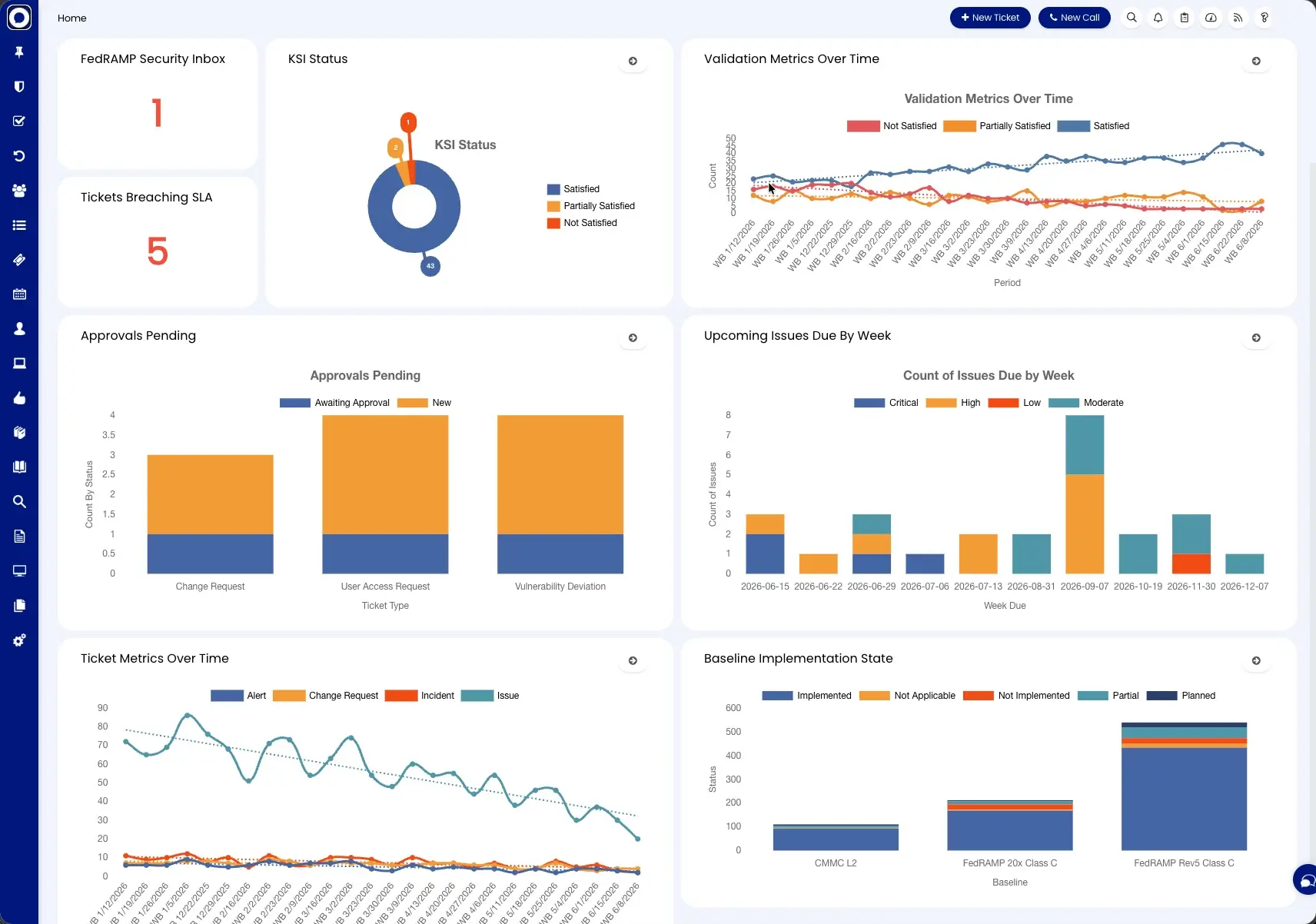
- Executive Dashboards. Real-time compliance posture, risk trends, SLA performance, and operational metrics at a glance.
- Ongoing Certification Reports. Live and historical views of all compliance data, available through the self-service portal. Human and machine-readable formats.
- Audit-Ready Exports. Pre-formatted deliverables for FedRAMP monthly reporting, 3PAO assessments, and agency reviews
- Operational Metrics. SLA tracking, ticket aging, resolution times, and workload distribution across teams
Compliance Framework Support
Stratus GRC-ITSM has built-in support for the compliance frameworks that matter to government and defense organizations.
Framework
What's Built In
FedRAMP Rev5
Recurring task schedules mapped to controls at Low, Moderate, and High baselines. Automated ConMon deliverables and reporting cadences. OSCAL-based system definition for machine-readable certification packages. Full support for the FedRAMP Consolidated Rules for 2026 rule families (see below).
FedRAMP 20x
Full KSI tracking: each Key Security Indicator tracked as a ticket with SLAs, automated and manual validation submissions, pass/fail criteria, and implementation summaries stored as Components and Implemented Requirements. KSI validation failures automatically create issue tickets. Stratus GRC-ITSM is FedRAMP 20x Moderate Authorized.
CMMC Level 1–3
The same GRC-ITSM capabilities applied to CMMC requirements. CMMC, FedRAMP Rev5, and FedRAMP 20x test the same operations; the framework determines the wording, the cadence, and the evidence format. Since all operations run through the platform, evidence of compliance is available as a byproduct of daily work, not a separate collection effort.
DoD CC SRG
Support for DoD Cloud Computing SRG Impact Levels IL2, IL4, and IL5. The same platform capabilities apply across all impact levels, with controls and reporting aligned to the applicable baseline.
Not a checkbox exercise: these frameworks are embedded into the platform’s task engine, reporting, and workflow automation so compliance activities happen as part of daily operations, not as a separate workstream.
Ready for the FedRAMP Consolidated Rules for 2026
FedRAMP now runs under one rulebook: the Consolidated Rules for 2026, released June 25, 2026 and effective July 4, 2026. The pilot-era Rev5 Balance improvements are now final rule families that apply to both Rev5 and 20x Certifications. Adoption is mandatory for all stakeholders on January 1, 2027, and the VDR (Vulnerability Detection and Response) and VER (Vulnerability Evaluation and Reporting) rules become mandatory December 7, 2026, to align with CISA BOD 26-04. Most providers will need to rebuild processes and adopt new tooling to comply. Stratus GRC-ITSM already supports these capabilities: they are how we earned our own FedRAMP 20x Moderate Authorization.
Rule Family
Status
How GRC-ITSM Supports It
FedRAMP Security Inbox
Mandatory since Jan 2026
Emails from FedRAMP and agency domains automatically create tickets with SLA tracking and POC notification. Failure to respond within required timeframes results in corrective action, up to suspension of FedRAMP Certification.
Secure Configuration Guide
Mandatory since Mar 2026
Built-in automated secure configuration checks with 30+ checks across all configuration types. Admins are notified of insecure configurations directly from the home screen.
Minimum Assessment Scope
Final rule family, effective Jul 4, 2026; Rev5 adopts by Jan 1, 2027
OSCAL-based system definition lets you narrowly define information resource boundaries with documented components, information flows, and third-party dependencies, exactly what MAS requires. Transition from traditional boundaries without rebuilding your documentation. What MAS requires and how to automate it.
Significant Change Notifications
Final rule family, effective Jul 4, 2026; Rev5 adopts by Jan 1, 2027
Change Management workflows already categorize changes by impact, track approvals, and generate notifications with required data (change type, timeline, business impact, approver details). Auditable change records maintained for 12+ months. Human and machine-readable notification formats supported. What SCN requires and how to automate it.
Certification Data Sharing (CDS), formerly Authorization Data Sharing
Final rule family, effective Jul 4, 2026; Rev5 obtains by Jan 1, 2027 and maintains by Aug 1, 2027
Trust center with just-in-time access to certification data in human and machine-readable formats. Granular RBAC, secure authentication, and full access audit logging. No manual approval cycles. The central FedRAMP repository retires by August 2027; a trust center is the path forward.
Vulnerability Detection and Response (VDR) + Vulnerability Evaluation and Reporting (VER)
Mandatory Dec 7, 2026 (per CISA BOD 26-04 alignment)
Full pipeline across both rule sets: enrichment with CISA KEV and EPSS, LEV and IRV determinations, PAIN (Potential Agency Impact N-rating, N1–N5), and remediation SLAs tighter than FedRAMP's recommended timeframes. 192-day accepted vulnerability tracking (VER-TFR-MAV) and reporting in required formats.
Collaborative Continuous Monitoring
Final rule set, effective Jul 4, 2026; Rev5 obtains by Jan 1, 2027 (grace to Oct 1, 2027)
Ongoing Certification Reports (OCRs, formerly OARs) generated from live platform data every quarter: vulnerability summaries, change logs, and security recommendations. All published through the trust center for agency review. Feedback mechanisms built in.
These are not future integrations. They are the capabilities we used to take Stratus GRC-ITSM through FedRAMP 20x Moderate Authorization. The system that authorized us is the system we operate from.
Workflow Automation
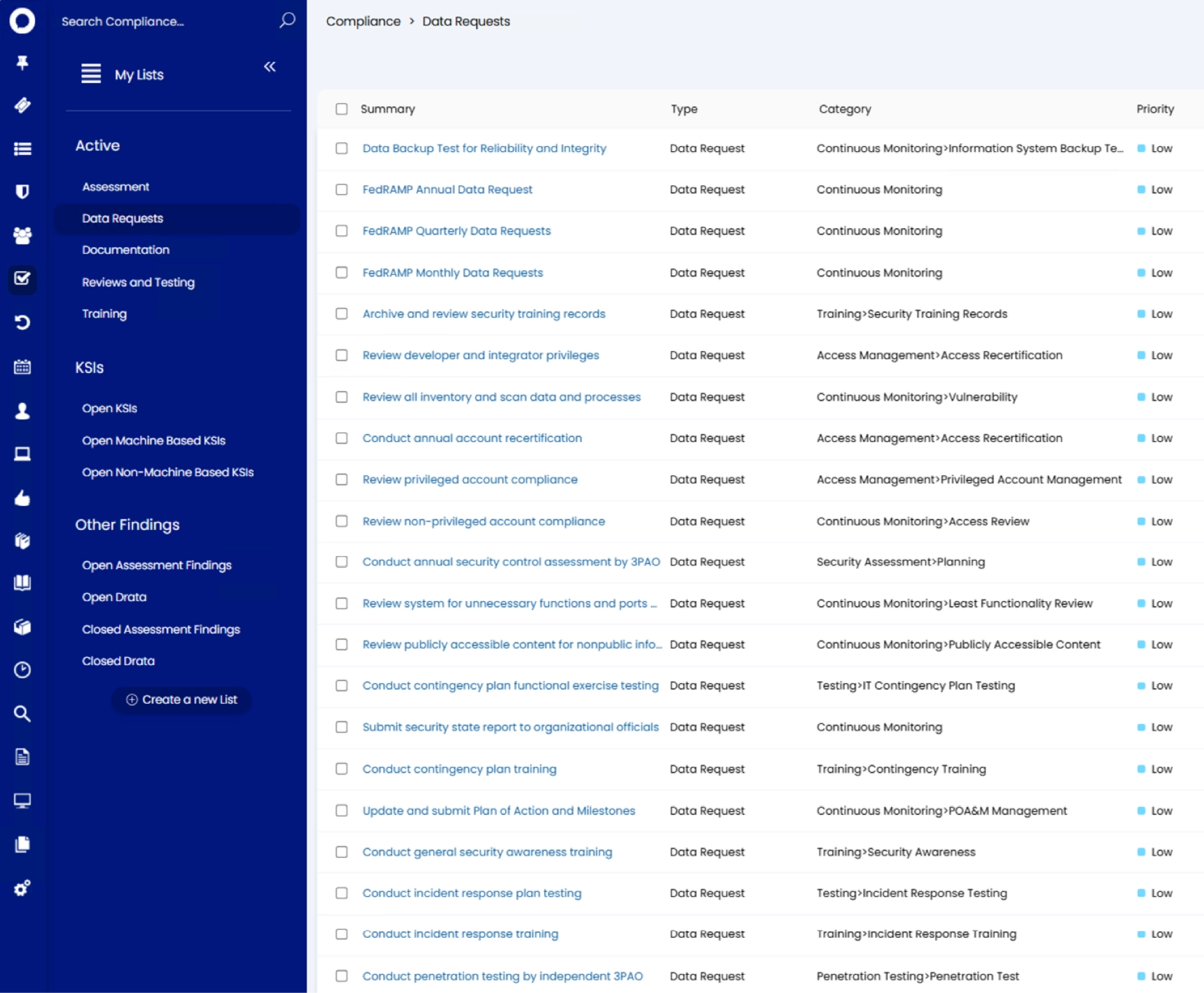
Compliance programs fail when recurring tasks slip through the cracks. Stratus GRC-ITSM automates the operational cadence of compliance.
What Gets Automated:
Weekly
Audit log review and analysis tasks created and assigned automatically
Monthly
Vulnerability scan reviews, POA&M updates, privileged account compliance checks, ConMon reporting packages
Quarterly
Public content reviews, developer privilege reviews, access recertification triggers
Annually
Policy review cycles across all 17+ control families, contingency plan testing, incident response exercises, security awareness training tracking, 3PAO assessment coordination
Each task is pre-mapped to its governing controls, pre-assigned to responsible roles, and tracked against its compliance deadline. Missed deadlines escalate automatically. How we built continuous monitoring across CMMC, Rev5, and 20x.
For FedRAMP 20x: KSI validations run continuously: the platform executes automated validations daily and manual validations at least quarterly. When a machine-based validation fails, an issue ticket is created automatically with the appropriate SLAs.
AI-Ready Platform
Stratus GRC-ITSM is designed for AI integration through MCP (Model Context Protocol), enabling contextualized, natural-language access to your compliance and operations data. Ask questions, surface risks, and generate insights directly from live platform data.
Who It’s For
MSSPs
Manage multiple client compliance programs from a single platform with granular RBAC and data separation. Consolidated reporting and standardized workflows across your portfolio.
Government Contractors
Run your CMMC and FedRAMP programs without hiring a GRC team or buying five separate tools. Built-in frameworks, automated task scheduling, and audit-ready deliverables from day one.
SaaS Providers
Accelerate your FedRAMP Certification with a platform that handles the operational burden of continuous monitoring, change management, and required reporting.
Government Agencies
Consolidate compliance operations across systems and programs. Standardized workflows, centralized risk visibility, and streamlined ATO processes.
Trusted By
0m+
SaaS Companies.
With their FedRAMP environments
0m+
Defense Contractors
With their CMMC programs
0+
Federal Agencies
Securing their cloud environments & applications
0+
Compliant Environment
Managed on the platform
0+
ConMon Packages
Delivered
FAQ
See Stratus GRC-ITSM in Action
See how Stratus GRC-ITSM can replace your tool sprawl and
accelerate your FedRAMP or CMMC journey.